
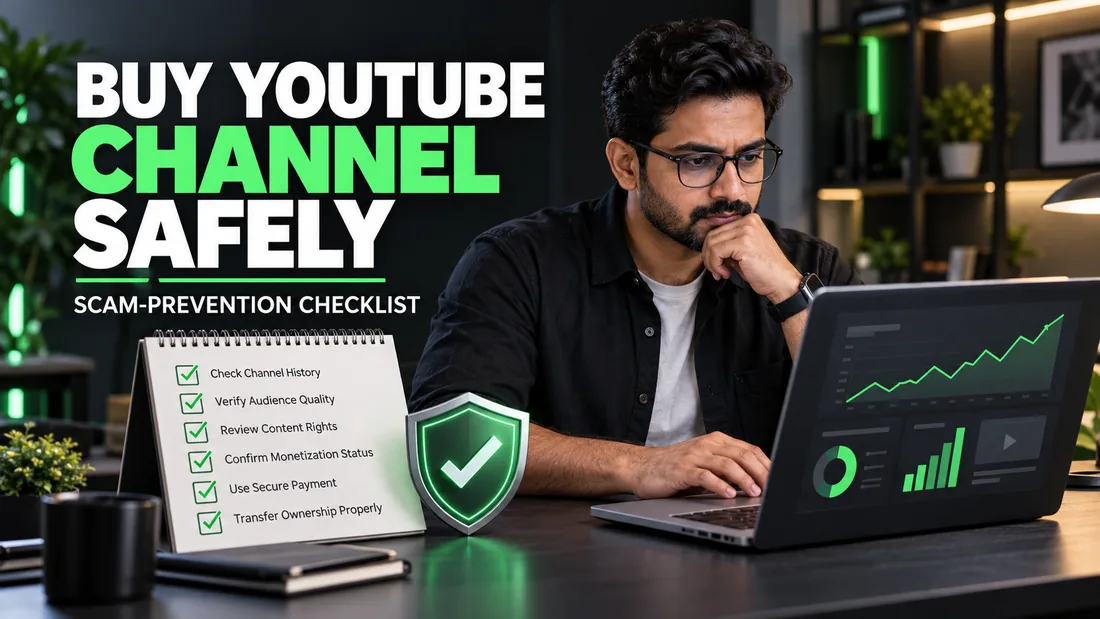
When someone asks me, “Is this YouTube channel safe to buy?”, I do not begin with subscriber count or the asking price. I begin with a simpler question: can every important claim be verified?
A channel may look impressive on the surface and still carry risks that only appear after a careful review. The safest approach is to slow the deal down, collect evidence and agree on a clear transfer process before paying.
This guide expands on the practical checks discussed in AccountVilla’s video about buying and selling YouTube channels safely.
Watch the AccountVilla video on YouTube
1. Verify the person who controls the channel
A screenshot is useful, but it is not proof of current ownership. Ask the seller to show the channel inside YouTube Studio during a live screen-sharing session. Match the channel handle, recent uploads and analytics dates. The objective is to confirm that the person negotiating the deal can actually manage the channel.
If the seller keeps avoiding a live verification or sends only cropped screenshots, pause the deal. A genuine seller should understand why ownership evidence matters.
2. Read recent analytics, not only lifetime numbers
Lifetime views can make an old channel look stronger than it is today. I prefer to review the last 28, 90 and 365 days. Look at traffic sources, returning viewers, audience geography and the videos producing most of the watch time.
One viral upload can distort the picture. Ask yourself whether the recent audience would genuinely watch the content you plan to publish after purchase.
3. Check monetization and policy history separately
“Monetized” should never be the end of the verification. Review the Earn section, active policy notices, copyright claims and community-guideline history. Also examine whether the channel depends on reused clips or content for which rights are unclear.
Monetization status can change. Treat it as a current condition supported by evidence, not as a permanent guarantee.
4. Understand what is included in the transfer
Before payment, write down exactly what the buyer will receive. This may include Brand Account ownership, channel assets, thumbnails, source files or related social handles. Do not assume that access to one Gmail account automatically transfers every connected asset.
For a Brand Account, ownership changes may involve platform waiting periods. The transfer plan should reflect the actual account setup rather than a promise such as “everything will be done in five minutes”.
5. Keep payment tied to clear milestones
A rushed advance payment removes the buyer’s strongest protection. Use a documented process in which each payment stage follows a specific verification or transfer milestone. Keep the amount, refund conditions and responsibilities in writing.
Avoid sending money to an unrelated name or account without an explanation that can be verified. Pressure, secrecy and constantly changing payment instructions are reasons to stop and reassess.
6. Discuss AdSense carefully
A YouTube channel and an AdSense account are not the same thing. Buyers should understand how the channel will be connected to an eligible payment account after transfer and what information can legally be changed. Do not ask for another person’s private tax or identity credentials.
If the monetization arrangement is unclear, resolve it before treating the deal as complete.
7. Preserve evidence before and after transfer
Save the agreed listing details, dated analytics evidence, payment records and the final transfer checklist. Once control changes, update recovery information, review permissions and remove access that is no longer required.
This record is useful if the buyer and seller later remember a term differently.
Warning signs I would never ignore
- The seller refuses a live YouTube Studio review.
- The asking price changes repeatedly without a clear reason.
- The channel’s largest videos do not match the proposed future niche.
- Copyright or policy questions receive vague answers.
- The seller demands full payment before ownership milestones.
- Analytics dates, channel handle or payment name do not match.
A safer decision is often a slower decision
Buying a YouTube channel is not a shortcut around due diligence. The buyer is taking over an audience, a content history and the consequences of earlier publishing decisions. Give yourself enough time to understand all three.
My practical advice is simple: verify ownership, verify recent performance, review policy risks, document the transfer and pay only through a process you understand. If the evidence is incomplete, walking away is a valid decision.
— Gyanendra Dwivedi
Ready to Buy or Sell a YouTube Channel?
Compare available channels or connect with the AccountVilla team for guided verification and ownership-transfer support.

Discussions 0